Τετάρτη 23 Ιουλίου 2014

Reiki Practice and Asperger’s


Since starting Reiki practice in 1986, I have offered Reiki healing and training to many families addressing Asperger’s or other diagnoses on the autism spectrum with good results. Let’s get the word around how much Reiki practice can help these families. Here an Australian mother shares her story.


Reiki Healing for Myself

and My Son

by Sacha Sampson


ASD. High Functioning Autism. Asperger’s Syndrome. I was somewhat familiar with those words, but never imagined they would be part of my life or our son’s. For many years, I’d looked for an answer to our son’s quirkiness. Everyone said he was just a normal kid. Then the meltdowns became violent. He would scream for hours in a total rage while his younger siblings hid in the corner.


Waiting for an Asperger’s diagnosis


By the time he was nine, I was begging our family doctor for help. He referred us to a paediatrician who specialises in autism. We waited eight months for the appointment. The meltdowns hit epic proportions not long before we got to the specialist. Our son was pulling knives on me and threatening to do horrible things to himself. It took the paediatrician a mere 45 minutes to diagnose Asperger’s Syndrome (high functioning autism, ASD) and anxiety. After nine years, I was relieved and grateful to finally know what was going on.


My new Reiki practice


I took a First degree Reiki class and began practicing on myself. As mum to four kids aged 2-11, it’s sometimes a challenge, but I manage to get my hands on myself every day, and meditate as the day allows. I also started practicing Reiki on my son, giving him a full treatment every other day. In the beginning, he was apprehensive and fidgety, so I shortened the time he was lying down and chatted to him about what we were doing. After three or four modified treatments, he knew what to expect and calmed down as soon as I started his treatment.


How Reiki practice helped my son


In the year since, he has moved from strength to strength. Previously when he felt anxious, he would become violent, spray expletives at us, and lash out at his siblings. Now he works through anxiety attacks and meltdowns without becoming violent. In the past, when a situation became overwhelming, he would scream and become angry. Now he knows when to take time to clear his head. His overall demeanor has improved. He now shows compassion and understanding towards others. The biggest change has been his new ability to maintain a friendship. Children with autism typically are not interested in creating relationships, so in the past, he would play by himself in the school playground. Now, after 12 months of Reiki practice, he has a friend who is patient and understanding and a great support. He has asked on a number of occasions to learn First degree. I don’t know which one of us is more excited. As he says, “Reiki Rocks!”


From: http://reikiinmedicine.org/reiki-stories/reiki-healing-aspergers/


Thank you Pamela Miles!

Τρίτη 7 Ιανουαρίου 2014

The I Practice Self Reiki Every Day Badge of Honor


When I learned to practice self Reiki in 1986, I had been a student of meditation and yoga for 25 years. I understood that, like meditation and yoga, Reiki is a spiritual practice. I knew if I wanted to be happy, to heal and to grow, I needed to practice self Reiki every day. So that’s what I did. And practicing self Reiki every day has made all the difference.


Do you practice self Reiki every day?


If you practice self Reiki every day, you too know the difference it has made in your health and well-being, in how you feel about yourself and your life, your sense of meaning, and the quality of your relationships. And when life got tough, you know how your daily practice sustained you. Knowing how profoundly your daily self Reiki has supported you, you want others to know Reiki practice can help them too.


Daily self Reiki, our primary value


The Reiki community is very diverse, yet practitioners from various lineages and practice styles practice their own version of self Reiki every day. Self practice is our primary value, a value which connects us beyond the diversity of our individual practice styles. Our daily Reiki self practice brings us home to ourselves, and unites us with all Reiki practitioners who value daily self practice. It’s time to share our primary value — the simplicity and effectiveness of daily Reiki self care — with the world.


Show the world you practice daily Reiki self treatment


Reiki is widely seen only as a treatment one gets from someone else. That’s too bad. We know Reiki is so much more than that; it is a simple, accessible practice for self care. How can we get that message to the public? I have an idea…


Post the I-Practice-Self-Reiki-Every-Day badge


It’s time people who practice daily self Reiki had a badge of honor — and now you do! I’ve made it very easy for you to tell your community you practice daily Reiki self treatment: a badge that can be freely and easily shared by everyone who shares the value of daily Reiki self practice. Telling people about your daily practice is a service to your community. If you are a home practitioner, it shares your Reiki enthusiasm with your friends so they can find out more if they want to. If you are a professional, it distinguishes you as a committed, serious Reiki practitioner, someone who walks the walk instead of just talking the talk. Knowing you value the practice enough to make it part of every day helps people who respect you to respect Reiki practice. Please publish this badge on your own site or Facebook page, or share it in an email. It’s easy — just copy and paste or drag and drop it where you want it. The badge links to a page that explains why your daily self Reiki is so important. Thank you for all you do to make thoughtful, credible approaches to Reiki practice visible to the mainstream public.


To show the world that you practice daily Reiki self treatment, drag and drop the badge or copy and paste the code into your blog post or web page!


http://reikiinmedicine.org/wp-content/uploads/2014/01/Self-Reiki-Badge.png


From: http://reikiinmedicine.org/daily-practice/practice-self-reiki/

Τετάρτη 18 Δεκεμβρίου 2013

Mild depression tied to diabetes complications


Mild depression tied to diabetes complications
BY BENJAMIN STIX

NEW YORK Tue Dec 3, 2013 10:45am EST
(Reuters Health) - Even mild bouts of depression may worsen the health complications that often go along with type 2 diabetes, according to a new study.

Canadian researchers followed more than 1,000 patients for five years and found those who experienced multiple episodes of low-level depression were nearly three times more likely than those without depression to have greater disability, such as reduced mobility, poor self care and worse quality of life.

"Minor depression is a form of chronic stress," said Dr. Norbert Schmitz, associate professor of psychiatry at McGill University's Douglas Mental Health University Institute in Montreal, who led the study.

"Patients may not be able to follow treatment guidelines or they may have problems with diet, which in turn results in an increased risk of poor functioning," he said.

Diabetes can increase the risk of heart disease, nerve damage, kidney failure and blindness. The disease affects 25.8 million people in the U.S. and that number is expected to rise dramatically during the next 20 years, according to the Centers for Disease Control and Prevention.

Type 2 diabetes is often associated with obesity, but the elderly are also at high risk, with an estimated 27 percent of the over-65 population suffering from the disease.

Past research has found that nearly one-fifth of type-2 diabetics in the U.S. experience major depression, which is almost twice the rate seen in the general population. Some studies also link the combination of type 2 diabetes and depression with difficulty managing blood sugar levels and other health complications as well as increased risk of death.

Most research to date has focused on the role of major depression in poor health outcomes for diabetes patients, but Schmitz and his colleagues wanted to know if mild depression symptoms carried the same risks.

For their study, published in Diabetes Care, the researchers followed 1,064 adults, aged 18 to 80 years old, from the larger Montreal Diabetes and Well Being Study for five years.

The participants received a battery of surveys that assessed symptoms of depression, measures of disability, quality of life, diabetes-related health complications, social background, exercise and medical and psychiatric history, particularly related to treatment for depression.

The study team defined depression by a score based on symptoms experienced over a period of two weeks. While major depression would require at least five out of nine symptoms - such as appetite changes, fatigue and suicidal thinking - persisting over that time, mild depression would constitute fewer than five symptoms experienced at least once over the previous two weeks.

The researchers also looked at health-related quality of life, based on the individuals' own perceptions of how burdensome their health problems were, and translated into a number of "unhealthy days" the person reported over the past month.

They found that as the number of episodes of mild depression increased, the risk of impaired health and quality of life grew as well. For participants with one minor depression episode, the rate of poor functioning in daily activities such as work, domestic responsibilities and self-care was 50 percent higher compared to those who had no depression.

For patients with four or more bouts of mild depression, the risk of poor functioning was almost 300 percent greater and the risk of impaired health-related quality of life was nearly 250 percent greater than for those without depression.

Schmitz told Reuters Health the study points to the need for broadening patient care options.

"It is important not to separate treatment for depression from treatment for diabetes," he said. "Depression is associated with poor diabetes management. If management of diabetes is stressful, people may not follow guidelines. We need to look at the whole picture, what are the mental problems, physical problems, and try to find an integrated treatment approach to those with symptoms of depression."

"Research has shown that integrated treatment is more effective and better at focusing on the individual," Schmitz added. "But this approach is a recent development and integrated treatments are not widely available."

Dr. Roger McIntyre, a professor of psychiatry and pharmacology at the University of Toronto who was not involved in the study, agreed diabetes patients should get early treatment with therapy for minor depression, while doctors also take a more holistic approach towards treating diabetes, including helping patients improve their quality of life and ability to care for themselves.

"This obviously requires an intensive resource-heavy approach," McIntyre said. "And the reality is that these resources are not available and patients need to be self managers and need to work in partnership with providers."


SOURCE: bit.ly/IyqIM0 Diabetes Care, online November 6, 2013.


FILED UNDER:HEALTH


From: http://www.reuters.com/article/2013/12/03/us-mild-depression-diabetes-idUSBRE9B20PH20131203

Σάββατο 16 Νοεμβρίου 2013

Usui’s Gakkai

In our conversation about Reiki practice and money, Reiki master and Buddhist monk Hyakuten Inamoto referred to the Gakkai, the organization started by Reiki practice founder Mikao Usui. We continue the conversation below. At the end, my Japanese colleague shares facts relevant to the story that Usui spent seven years living with beggars.
Pamela Miles: Please tell us more about the Gakkai.
Hyakuten Inamoto: The Gakkai had no Reiki classes or seminars, only Reiki gatherings. That’s why people paid a fee to become a member. Then as a member, they could attend a Reiki gathering without paying an additional fee.
The highlight of the Gakkai’s Reiki gathering is receiving reiju from the shihan (Reiki master) who was in charge of the gathering.
Reiju was part of every gathering. The gatherings were held weekly, especially in the head office in Tokyo.
When Usui sensei was alive, there were more than 60 local chapters, and that number declined after World War II.
Now there are only two local chapters, one in Kobe, a port city in western Japan, and a local chapter in Tokyo. Besides the local chapter, the head office of the Gakkai is also in Tokyo. I don’t know how often the local chapters hold gatherings now.
In a way, Reiki practice went underground in Japan. Many Gakkai members died during the war. The head office was in Tokyo, and there were air raids. The office was destroyed in the war and we don’t know if any archives survived.
So new Gakkai has no archives or papers. I tried to gather information again but found it very difficult. However, we haven’t lost everything.
The Gakkai now has only about 200 members, and it is a closed-door society. Reiki practitioners of other styles are not welcome in the Gakkai. Only people who are new to Reiki might be invited to join. Hiroshi Doi was allowed to join the Gakkai through introduction. Then the Gakkai became closed.

PM: On another note — can we set the history straight about Usui spending seven years offering Reiki treatment to beggars in the slums of Tokyo?


HI: No, we know for sure that did not happen. Usui had no time for that. He was on Kaurama in 1922 and passed away in 1926, very limited time. My personal feeling is that Usui sensed he didn’t have much time.


From: http://reikiinmedicine.org/reiki-basics/mikao-usui-gakkai/

Σάββατο 9 Νοεμβρίου 2013

Reiki Healing and Money with Hyakuten Inamoto

While contemplating how to engage the community in a productive conversation about Reiki healing and money, I thought to discuss the subject with Hyakuten Inamoto, an internationally respected Reiki master who has been an ordained, unaffiliated Buddhist monk for more than 40 years.
Reiki and Money:

A Conversation with Hyakuten Inamoto

  Pamela Miles: Western Reiki practitioners often have discomfort and misunderstanding about money and spiritual practice. Please speak to us about the value of money.
  Hyakuten Inamoto: Money is beyond good or bad, it is neutral. The question is how we use it. It is okay to make a lot of money.
If we use money not only for our own interest, but for the good of people, for sharing, then money becomes good money.
If we use it only for our own interest, then money is not good. My personal view is that it’s ok for us to make money. We don’t have to feel guilty.

Reiki fees charged by Usui and Hayashi

  PM: As a Japanese native residing in Kyoto, you are able to do original research into the history of Reiki practice. Please tell us about the fee structure in Usui’s time and Hayashi’s time.
  HI: At the time of Usui-sensei and Hayashi sensei, it cost a lot of money to become a Reiki practitioner. Only wealthy people could afford to become First and Second degree practitioners.
The Gakkai is a membership association; in order to learn Reiki practice with the Gakkai, you need to become a member.
One member complained about this from the start, why do you charge so much money? Reiki is a gift from the heaven – why do you charge? So he left Gakkai after two years.
  PM: Why did Usui and Hayashi charge such fees?
  HI: I don’t know why Usui or Hayashi charged high fees. Hayashi charged 50 yen at that time. He taught a five-day workshop to minimum of 10 students. At that time, it was a lot of money.
I asked my teacher, Mrs. Yamaguchi, “What could you do with 500 yen?” She said you could buy a small house.
My understanding is that Mrs. Takata followed the traditional Japanese way of high fees and mostly oral teaching.
  PM: Where did you get that information?
  HI: I gathered that information from several Gakkai members, including Hiroshi Doi.
On Mount Kurama, in March 1922, Usui sensei attained enlightenment. He then returned to Tokyo, and in April, Usui opened the Gakkai.
Usui said, no one taught me this and I didn’t study to obtain this ability; I accidentally realized I was given this mystical ability to heal, not before Mt. Kurama, but after.
Then Usui started teaching and giving healing in his dojo. There was no set fee for receiving treatment.
Usui became well known for hands-on healing. He was not the only person who offered hand energy healing but he became very well known.
People in other areas invited him to come teach and he was on the road many times because he wanted to share this gift with as many people as possible.
In a way, perhaps he worked too hard, and passed away in Hiroshima area while traveling.
We don’t know how he charged but he always traveled to naval bases because the imperial navy of Japan was supporting Usui Reiki Ryoho.

Japanese culture and money

  PM: Please speak about the Japanese cultural perspective on money and spirituality.
  HI: I don’t know about Usui sensei’s viewpoint on money, but to Japanese people in general, there is something kind of negative around money. In Japan, you don’t talk about money face to face. It’s considered rude to talk directly about money.
Of course everyone knows there is money, but you don’t talk about it openly. There is a cultural reluctance to speak about money openly because Japanese culture sees money as kind of dirty. It might be a feeling something like money is the root of all evil.
Personally I don’t agree that money is root of all evil. Money is neutral, not good or bad. It all depends on how we use money, and on the situation.
  PM: Is it accurate to say that Japanese people do not have an expectation that spiritual training should be free?
  HI: I personally do not think that training should be free. Free is not good. If we get something for free, we don’t appreciate it very much.
It is not so much a question of the amount of money, but if we pay some money for something, it is a gesture of appreciation for what we receive.
My personal feeling is, no fee, no charge, no good. I don’t agree with that approach.
Basically, I charge a fee for treatment but it also depends on the situation. If a person has no money, is very poor, I offer my Reiki healing as my blessing, my donation, my contribution.
When it comes to classes, of course I charge a fee. I will not train someone to practice Reiki without a fee. Maybe a student cannot afford to pay in full; maybe he can afford only 10%. I might say okay.
To me, paying some fee is a gesture of appreciation. If you can afford the usual fee, it’s not the amount of money, it’s your appreciation. But never totally free, especially not for Reiki classes.
  PM: Am I correct in understanding that you draw a distinction between fees for treatment and for training?
  HI: Yes, I have a different feeling about the importance of charging for Reiki training than Reiki treatment.
Spiritual teachings are available in Japan both for free or for fee, but spiritual teachers in Japan tend to charge something. Both Usui and Hayashi would have known this.
  PM: And as we saw with Usui and his students offering Reiki treatment after the Tokyo earthquake, when there is a disaster or an emergency, there is not a fee for treatment.
  HI: Agreed.
  PM: What did you learn from Mrs. Yamaguchi, your Reiki master, about fees and money?
  HI: Mrs. Yamaguchi didn’t mention anything about money. When she said, “Okay, I’m going to teach you,” I asked how much should I pay. She said, “Never mind the money, I am happy to share Reiki practice with you.”
But I was not comfortable with that, so I offered a gift not in form of money, and she accepted. Then we were both comfortable.
Perhaps if not in the form of money, at least we can offer something as a gesture or token of appreciation and respect.
  PM: Mrs. Takata lived in the Hayashi compound, where the family home and the Reiki clinic were located. What is the significance of that? How unusual was this arrangement?
  HI: This was a very unusual arrangement, and a significant acknowledgment that Hayashi sensei considered Mrs. Takata to be a special student.
It means he found Mrs. Takata to be a very special person. That’s why he invited her to live with his family. That’s my understanding.

Τετάρτη 6 Νοεμβρίου 2013

Reiki and the Birth Experience


Originally from the Ontario Reiki Programme Centre
www.magma.ca/~peterz/index.htm – given to The Healing Pages by kind permission


This essay looks at impending parenthood and how a hands-on therapy called Reiki can be used to help improve the whole family’s experience through pregnancy, delivery, and post-partum.
We begin by examining how Reiki is used to help deal with an issue common in all phases of pregnancy: the need to reduce pain. Unfortunately, pain sometimes plays a significant role in the mother’s experience throughout, including foot and back pain in pregnancy, labour pains during delivery, and engorgement and sore nipples post-partum. Fortunately, Reiki can be used throughout to improve that experience.
After examining the application of Reiki to the unique aspects of pregnancy, labour, and the post-partum period, we look at this therapy in the context of caregiving, including how dad (as I will refer to the pregnant woman’s caring partner) can participate more fully through providing care for mom and baby.
(Most published studies on Reiki have been done treating HIV/AIDS, chronic pain, and cancer. Pregnancy and childbirth – while not illnesses – can cause some of the same problems: pain, nausea, anxiety, and difficulty sleeping are all symptoms of these conditions, and are also often experienced during pregnancy, labour, and the post-partum period. We will update this paper with any new studies that relate specifically to pregnancy, labour, and post-partum application of Reiki, however where those are not available, studies that may relate from other contexts are quoted. )

Pain


The most common sources of pain in a pregnancy without complications are the back and feet. During labour, it is the labour itself, pressure between the baby and nerves in the lower back, and due to episiotomies or tearing. Post-partum, pain can come from engorgement, healing episiotomies or tearing, and painful nipples from nursing.

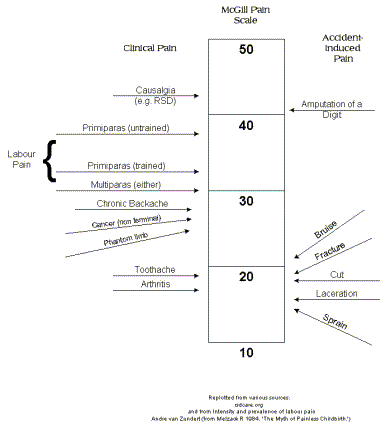
Back pain in pregnancy can be due to the increase in the mother’s weight and its distribution, as well as due to increased muscle strain due to the hormonal changes affect on her pelvic ligaments. Complications may include such things as the mother having a condition that the pregnancy stresses (e.g., arthritis), which will exacerbate the problem. The figure[i] above shows the intensity of back pain on the McGill pain scale (which rates pain from 0-50 in increasing intensity). Back pain (chronic backache on this scale) can be moderately severe.
Labour pain is potentially quite a bit more severe, however even simple training in breathing techniques, relaxation and general understanding of what is likely to happen will reduce anxiety and pain (primiparas  – first birth) significantly (trained versus untrained in figure). Training that includes an effective relaxation and pain-reduction tool like Reiki will reduce perceived pain even further.
Jeri Mills, M.D., used Reiki for over 10 years in her OB/GYN practice and has documented her experiences in a book “Tapestry of Healing: Where Reiki and Medicine Intertwine.” [ii]  She describes many cases, but summed it up with “Most women slept through the first half of labor, some slept through their entire labor with only Reiki for pain control.” [iii]
Reiki is used in many programmes for pain management and reduction including in oncology, chronic pain, and palliative care clinics, including the NIH Hospital in Washington’s Pain and Palliative Care Clinic[iv] – they use Reiki for severe pain including Fibromyalgia. There is anecdotal evidence that Reiki has been successfully used in the treatment of the pain associated with RSD (“causalgia”)[v].

Pregnancy

For some women, nausea accompanies pregnancy – usually worst during the first trimester, but sometimes throughout the pregnancy. There is a reasonable body of anecdotal evidence to support the use of Reiki to ease morning sickness. Dr. Usui’s original healing guide[vi] identifies morning sickness as treatable using Reiki, and also states that treating the womb results in a healthy fetus and easy birth.
The Hartford Hospital in Hartford CT has been doing Reiki in their inpatient Gynecological Surgical unit in 1997[vii], now extended to other units. “From January through June of 2002 approximately 1,480 Reiki sessions were provided at Hartford Hospital…; Surveys show that Reiki (reduced) stress/anxiety an average of 94%, nausea 80%, pain 78%, and improved sleep 86%.” [viii]
Dr. Beverly O’Brien & Margaret Mauro of the Perinatal Research Centre U of Alberta have just completed a study on the effect of Reiki on levels of anxiety in women undergoing diagnostic amniocentesis.[ix]  (Study is complete, but not published.)

Labour

Dr. Jeri Mills’ experience on two important labour concerns, the difficulty and length of labour, and the need for C-sections:
·         “Besides helping with pain control in labor, Reiki seems to make people labour faster and deliver more easily.” [x], and 
·         “Women who had previous caesarian sections for seven pound babies deemed too large to fit though their pelvis were having vaginal deliveries of nine and ten pound babies. My c-section rate declined from approximately 20% to 5%.” [xi]
Some examples of hospital programmes are Dublin Maternity Hospital, which provides Reiki practitioners on-call[xii]; the Hallmark Health Corporation in NH[xiii]provides Reiki in hospital, along with other holistic aids for pain during childbirth.

Post-partum

Forty to 85 percent of women experience intense highs and lows as they adjust to life with a new baby. For about ten to fifteen percent of women and more than a fourth of all adolescent mothers, childbirth results in postnatal depression.[xiv]Causes include hormonal adjustment and the stress of being a full-time caregiver.
Sixty-one percent (61%) of “intense” family caregivers – those providing at least 21 hours of care a week – have suffered from depression[xv]. Mothers with newborns are generally not considered in these statistics, as the intent is people caring for the ill or infirm. However, the mother of any newborn provides far more care than 21 hours a week, and has the additional disruption to sleep, hormonal levels, and her other relationships to contend with. Caregiver stress and burnout assessments[xvi]list exhaustion, a sense of excessive responsibility, sleep disturbances, and emotional outbursts as signs of caregiver burnout. Care has to be taken for the new mother to avoid such a condition.
An early study[xvii] found that “Reiki is an effective modality for reducing …;depression, and anxiety”, and a recent review of Reiki practice in the US found that hospital “…;staff, patients, and program administrators report a number of benefits including reduced anxiety and …;decreased numbers of self-reported common gerontological complaints such as anxiety, loneliness, insomnia, and pain…;” [xviii] (Anxiety, and loneliness are not restricted to gerontology.)

Infant Care

Infant care begins at the moment of birth, and Reiki can be used right away: “At New York’s Continuum Center for Complementary Care, pediatrician Larry Palevsky, M.D., uses Reiki on babies and children. “I first began using it in the delivery room,” Palevsky recalls. “If a newborn had good vital signs, but wasn’t very responsive, instead of slapping him or her, which was the normal procedure, I would lay my hands on the infant for ten minutes or so and just watch him wake up. ” Now, as a holistic pediatrician, Palevsky often performs Reiki on his pint-sized patients, who are highly responsive to it, he claims.”[xix]
Using Reiki on infants is a lot like caring for anyone else – anxiety, sleep problems, pain (gas, colic) all affect infants and Reiki can be used with no contraindications. A study of “Gentle Healing Touch” (GHT) on preterm infants reported that: [xx] “There were significantly lower levels of active sleep, motor activity, and behavioral distress during GHT compared to (baseline) and (post-touch) phases. There were no differences among the 42 infants in the GHT group and 42 infants in a randomly assigned control group on any outcome variable including weight gain, morbidity status, or behavioral organization. The findings suggest that GHT generally is a safe and soothing type of touch to provide to young preterm infants, but that individual infant responses to touch need to be continuously monitored by NICU staff and parents.”
In a further study performed using touch with premature infants in an intensive care situation, the author concluded that “touch promotes bonding and well-being and is therefore an essential therapy for the benefit of parents, babies, and health care professionals”[xxi] and noted in the published abstract that the study results had affected her own practice.

Partner Support

Many dads are looking for ways to get involved and to provide as much substantial support as possible through the pregnancy, birth, and of course with the new infant.  Reiki is a tool to allow him to provide that support.
There are significant stresses on the couple and their relationship imposed by an infant in the family; Reiki provides a tool that helps maintain intimacy and care in the relationship, while reducing stress and exhaustion for both partners[xxii].  In a qualitative study of five postpartum women who participated in therapeutic touch during home visits focused on postpartum issues and concerns, [xxiii] the women felt: relaxed, open, cared for, connected, and skeptical (presumably of the type of treatment). “Although it is unknown whether it was the visit, the interaction, or the therapeutic touch that helped the women feel cared for, the experience of participating in therapeutic touch seemed to add a dimension of mutual caring that added a special and unique quality to the home visit.” (We feel that Reiki would provide the same quality, though it was not studied.) We suggest that the couple’s post-partum relationship would benefit from their sharing the feelings described (with the possible exception of skepticism).
A Reiki-trained dad can
·         Treat himself, when he feels stressed or tired
·         Treat mom, during all stages of the pregnancy, labor, and afterwards, not only to help look after her health, but to remain connected with her (as new mothers do not always have the energy left to provide emotional connection to dad).
·         Trhe infant, for example if (s)he is upset or awake in the middle of the night. (Always consult a doctor first if there is any chance that the infant is unwell or injured.)
Reiki provides a beeat tnefit to the person giving the treatment, as well as to the recipient, so that dad’s health and stress levels improve by helping mom and baby. Learning Reiki provides dads with a concrete tool that benefits the entire family.

Summary

Reiki therapy is safe and non-invasive. It is being used to facilitate relaxation and recovery, decrease anxiety and treat pain[xxiv] in hospices, nursing homes, emergency rooms, operating rooms, organ transplantation care units, pediatric, neonatal and OB/GYN unitsReiki can be used to help improve the whole family’s experience through pregnancy, delivery, and post-partum. It has been shown to be useful in dealing with pain, including labour pains during delivery, can reduce stress and anxiety post-partum, and provides partners a tool to participate more fully through providing care for mom and baby.  Reiki can be provided by mom herself, her partner, and by health care professionals.
Acknowledgment: I am very grateful for the assistance of Jeri Mills M.D., who provided valuable input and guidance in the preparation of this document.
The Ontario Reiki Programme Centre is an Ontario not-for-profit corporation dedicated to providing Reiki programmes in health care centres. They provide presentations, training and treatments, and have a comprehensive website (at www.onreiki.com) of research on this non-invasive therapy. Therapists and teachers are registered with the Canadian Reiki Association. These articles are presented as part of our mandate to inform people who may benefit from Reiki that this therapy exists, and how it has been shown to apply. This material may be used to promote Reiki and Reiki programmes in health care centres so long as the material is used intact and includes the copyright and attribution.
Reiki is a complement to treatment by a physician. It does not provide services in lieu of a doctor, nor is it a medical diagnostic tool. However, there is a growing body of opinion that integrative medicine that takes advantage of all parts of the care spectrum as appropriate is more effective (and cost-effective) than allopathic treatment alone.
Author: Peter Zorzella, BASc, RT-CRA, founded the Ontario Reiki Programme Centre to make healing through Reiki available to everyone who could benefit from it. Peter is a registered teacher with the Canadian Reiki Association; in addition to the work associated with the Centre, he has a clinical practice South of Ottawa.

References:


Τρίτη 5 Νοεμβρίου 2013

THE SCINCE BEHIND REIKI


What Happens in a Treatment?


Independent research by Dr. Robert Becker and Dr. John Zimmerman during the 1980's investigated what happens whilst people practice therapies like Reiki.  They found that not only do the brain wave patterns of practitioner and receiver become synchronised in the alpha state, characteristic of deep relaxation and meditation, but they pulse in unison with the earth's magnetic field, known as the Schuman Resonance.  During these moments, the biomagnetic field of the practitioners' hands is at least 1000 times greater than normal, and not as a result of internal body current.  Toni Bunnell (1997) suggests that the linking of energy fields between practitioner and earth allows the practitioner to dr.aw on the 'infinite energy source' or 'universal energy field' via the Schuman Resonance.  Prof. Paul Davies and Dr. John Gribben in The Matter Myth (1991), discuss the quantum physics view of a 'living universe' in which everything is connected in a 'living web of interdependence'.  All of this supports the subjective experience of 'oneness' and 'expanded consciousness' related by those who regularly receive or self-treat with Reiki.

Zimmerman (1990) in the USA and Seto (1992) in Japan further investigated the large pulsating biomagnetic field that is emitted from the hands of energy practitioners whilst they work.  They discovered that the pulses are in the same frequencies as brain waves, and sweep up and down from 0.3 - 30 Hz, focusing mostly in 7 - 8 Hz, alpha state.  Independent medical research has shown that this range of frequencies will stimulate healing in the body, with specific frequencies being suitable for different tissues.  For example, 2 Hz encourages nerve regeneration, 7Hz bone growth, 10Hz ligament mending, and 15 Hz capillary formation.  Physiotherapy equipment based on these principles has been designed to aid soft tissue regeneration, and ultra sound technology is commonly used to clear clogged arteries and disintegrate kidney stones.  Also, it has been known for many years that placing an electrical coil around a fracture that refuses to mend will stimulate bone growth and repair.
Becker explains that 'brain waves' are not confined to the brain but travel throughout the body via the perineural system, the sheaths of connective tissue surrounding all nerves.  During treatment, these waves begin as relatively weak pulses in the thalamus of the practitioner's brain, and gather cumulative strength as they flow to the peripheral nerves of the body including the hands.  The same effect is mirrored in the person receiving treatment, and Becker suggests that it is this system more than any other, that regulates injury repair and system rebalance.  This highlights one of the special features of Reiki (and similar therapies) - that both practitioner and client receive the benefits of a treatment, which makes it very efficient.
It is interesting to note that Dr. Becker carried out his study on world-wide array of cross-cultural subjects, and no matter what their belief systems or customs, or how opposed to each other their customs were, all tested the same.  Part of Reiki's growing popularity is that it does not impose a set of beliefs, and can therefore be used by people of any background and faith, or none at all.  This neutrality makes it particularly appropriate to a medical or prison setting.

FROM: http://www.reikiteaching.co.uk/page10.html